

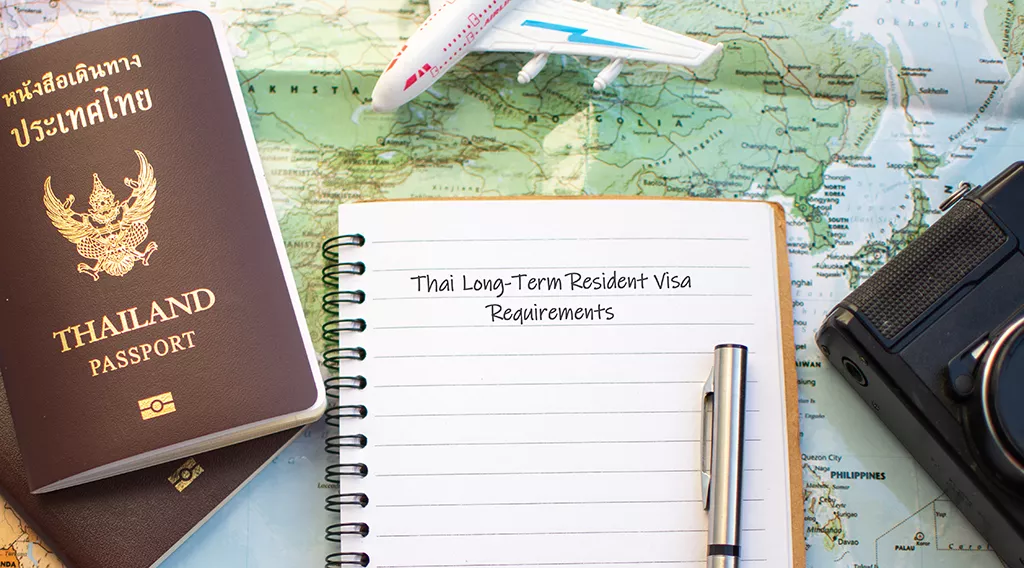
Thailand's Long-Term Resident (LTR) Visa is a 10-year renewable visa run by the Board of Investment (BOI) for four groups: wealthy pensioners, wealthy global citizens, remote professionals working for foreign employers, and highly skilled professionals. It comes with a digital work permit, a 17% flat tax rate for some holders, annual (not 90-day) immigration reporting, and a route to count Thai property investment toward eligibility. The visa fee is 50,000 THB, and approval typically takes around 20 working days.
Thailand introduced the LTR Visa in 2022 to attract long-term residents rather than short-stay tourists: specifically, foreign professionals, remote workers, retirees, and investors the government wants more of as it targets one million high-potential foreign residents over five years. Since launch, the Board of Investment has continued adjusting the rules, most recently easing the criteria for remote professionals in February 2025, so an accurate, current read of the requirements matters more than it used to.
Thailand LTR Visa at a Glance
| Questions | Answers |
|---|---|
| Issuing body | Thailand Board of Investment (BOI) |
| Visa length | 5 years, renewable once for another 5 years (10 years total) |
| Categories | Wealthy Global Citizens, Wealthy Pensioners, Work-from-Thailand Professionals, Highly-Skilled Professionals |
| Visa fee | 50,000 THB per person (10-year, multiple entry, collected in Thailand) |
| Work permit fee | 3,000 THB per year |
| Immigration reporting | Once a year, instead of every 90 days |
| Processing time | Around 20 working days for qualification endorsement |
| Dependents allowed | Up to 4 (spouse and children under 20) |
What the LTR Visa Gives You
Every LTR category shares the same core privileges:
- A renewable stay of up to 10 years (5 years initially, extendable by another 5 if you still qualify).
- Exemption from the standard 4-Thai-to-1-foreigner employment ratio, so Thai companies can hire you without adjusting their headcount.
- Fast Track lanes at Thailand's international airports.
- Annual immigration reporting instead of the usual 90-day report.
- A multiple re-entry permit built into the visa, so you don't need a separate one every time you travel.
- A digital work permit for holders who take up employment in Thailand.
- Tax exemption on foreign-sourced income remitted into Thailand.
- Access to the TIESC (Thailand Investment and Expat Services Center) at One Bangkok, a single office handling both visa and work permit matters. This replaced the older Chamchuri Square service point in 2025.
One privilege that's often misquoted: the 17% flat personal income tax rate applies only to Highly-Skilled Professionals, not to all four categories. The other three categories are taxed under Thailand's normal progressive rates on Thai-sourced income, though all four still get the exemption on remitted foreign income.
Who Qualifies: The Four LTR Categories
All four categories also require one of the following: health insurance covering at least USD 50,000 (with at least 10 months of validity remaining when you apply), enrollment in Thai social security, or a bank deposit of at least USD 100,000 held for 12 months.
| Category | Income / net worth | Investment required | Extra conditions |
|---|---|---|---|
| Wealthy Pensioner (age 50+) | USD 80,000/year passive income, or USD 40,000 to 80,000 | USD 250,000 if income is in the USD 40,000 to 80,000 range | Income must be passive: pensions, rent, dividends, capital gains, or interest |
| Wealthy Global Citizen | USD 1 million net worth, plus USD 80,000/year average income (last 2 years) | USD 500,000 in Thai government bonds, a Thai company, or Thai property | None beyond the investment |
| Work-from-Thailand Professional | USD 80,000/year average income (last 2 years), or USD 40,000 to 80,000 with a master's degree or higher | None | Employer must be publicly listed, or a private company operating 3+ years with USD 50 million+ combined revenue over the last 3 years |
| Highly-Skilled Professional | USD 80,000/year average income (last 2 years), or USD 40,000 to 80,000 with a relevant master's degree; exempt if employed by a Thai government agency | None | Must work in a BOI-targeted industry; 5 years' relevant experience required, unless you hold a PhD or work for a government, research, or higher-education institution |
Wealthy Pensioners
If you're 50 or older, this route works on passive income alone: pensions, rental income, dividends, capital gains, or interest, but not salary. USD 80,000 a year clears the bar outright. Between USD 40,000 and 80,000, you'll also need to put USD 250,000 into Thai government bonds, a Thai-registered company, or Thai real estate.
Wealthy Global Citizens
This category is built for investors rather than income earners. You need USD 1 million in assets and USD 80,000 a year in average income over the past two years, plus a USD 500,000 investment in Thai government bonds, a Thai company, or Thai property. Because property qualifies, this is the category where Storm Phuket clients most often combine an LTR application with buying a villa or condo (more on that below).
Work-from-Thailand Professionals
Built for remote employees of large overseas companies. As of February 2025, the BOI removed the 5-year work-experience requirement for this category and lowered the employer's combined-revenue threshold from USD 150 million to USD 50 million over the past three years. If your income sits between USD 40,000 and 80,000, a master's degree or higher can still make up the difference. Note this category doesn't receive a work permit, since you're employed remotely by a foreign company, not a Thai one.
If you're a freelancer or don't work for a company that meets these employer criteria, Thailand's separate DTV (Destination Thailand Visa) is usually a better fit than the LTR for remote work; it's a different visa with its own, lighter requirements.
Highly-Skilled Professionals
For specialists in BOI-targeted industries (advanced tech, digital, and similar sectors), employed by a Thai or foreign company, a Thai government agency, or demonstrating BOI-recognized expertise. Five years of relevant experience is required unless you hold a PhD or work in government, public research, or higher education. This is the only category that gets the 17% flat tax rate.
Bringing Your Family: Dependents
Spouses and children under 20 can join on a dependent visa, up to 4 dependents per LTR holder. Each dependent needs their own qualifying financial proof: a USD 25,000 bank deposit held for 12 months, health insurance, or Thai social security. Legally married same-sex couples qualify; unregistered partnerships don't.
How to Apply for the LTR Visa
- Check eligibility against the category that fits you, then download the BOI's document checklist and gather everything required.
- Submit your application online through the official LTR Visa portal at ltr.boi.go.th.
- Wait for qualification endorsement, typically around 20 working days. The BOI may request additional documents during this stage, which can extend the timeline.
- Collect your visa at a Thai Embassy or Consulate abroad, or at the TIESC in Thailand, once endorsed. The 10-year, multiple-entry visa fee is 50,000 THB per person in Thailand (higher through overseas agents or embassies).
- Apply for your work permit, if you'll work for a Thai employer, through the LTR system immediately after receiving your visa or before starting work. This takes 3 to 5 working days and costs 3,000 THB per year. You can legally work while it's processing. Work-from-Thailand Professionals skip this step entirely, since their employer isn't based in Thailand.
For the current document checklist and application forms, see the BOI's required documents page.
LTR Visa vs. Thailand Elite Visa
Both are long-stay options aimed at different priorities:
| LTR Visa | Thailand Elite Visa | |
|---|---|---|
| Issued by | Board of Investment | Thailand Privilege Card Co. |
| Length | 5 years, renewable to 10 | 5 to 20 years, depending on tier |
| Right to work | Yes, for 3 of 4 categories | No |
| Financial bar | Income and/or investment thresholds | Membership fee only |
| Best for | Retirees, investors, and remote/skilled professionals who meet income tests | Anyone wanting long-stay convenience without income proof |
If you don't clear the LTR's income or investment thresholds, our Thailand Elite Visa guide covers the alternative in detail.
Why This Matters if You're Buying Property in Phuket
Two of the four LTR categories let you satisfy the investment requirement with Thai real estate: USD 500,000 for Wealthy Global Citizens, or USD 250,000 as the top-up for Wealthy Pensioners earning USD 40,000 to 80,000. In practice, that means a villa or condo purchase in Phuket can do double duty: it's the property you wanted anyway, and it's also the investment that unlocks your visa.
If you're weighing this route, it's worth reading our foreign ownership legal guide to understand how non-Thai buyers can hold title, and our step-by-step buying guide for foreigners for the purchase process itself. If you'd rather see what qualifies first, browse current Phuket listings in the USD 250,000 to 500,000+ range.
Frequently Asked Questions
Does buying property in Thailand count toward the LTR visa?
Yes, for two categories. Wealthy Global Citizens can meet their USD 500,000 investment requirement with Thai property, and Wealthy Pensioners with USD 40,000 to 80,000 in passive income can use Thai property toward their USD 250,000 top-up investment.
How much does the LTR visa cost in total?
The visa itself is 50,000 THB per person for a 10-year, multiple-entry permit issued in Thailand (higher if arranged through an overseas embassy or agent). Add 3,000 THB per year if you also need a work permit.
What changed for Work-from-Thailand Professionals in 2025?
The BOI removed the 5-year work-experience requirement and lowered the required employer combined revenue from USD 150 million to USD 50 million over the past three years, making this category noticeably easier to qualify for than at launch.
Can my spouse and children come with me?
Yes. Up to 4 dependents (spouse and children under 20) can apply for a dependent visa, each needing their own qualifying insurance, social security, or bank deposit.
Does the LTR visa lead to Thai permanent residency or citizenship?
Not automatically. The LTR is a long-stay visa in its own right, not a fast track to permanent residency or citizenship, which have separate application processes and requirements.
Where do I apply for the work permit now?
At the TIESC (Thailand Investment and Expat Services Center) at One Bangkok, which took over this service from the previous Chamchuri Square office in March 2025.